
The Amazon Sellers Who "Buy Deep" and Purchase 90 Days of Inventory at Once

There's a pattern among the fastest-growing Amazon sellers that doesn't get talked about in most seller communities.
While most sellers restock in 30-day batches because that's what their cash position allows, a cohort of wholesale and established private label sellers do something different: they buy 90 days of inventory in a single order, pay their supplier on Day 1 of the invoice, and capture bulk and early-payment discounts that make their per-unit costs 15-20% lower than the seller next to them on the same listing.
Amazon seller communities call this "buying deep." The economics behind it explain why the sellers who can do it tend to keep doing it.
Who Buys Deep
This isn't a strategy for first-year sellers with $3,000 in startup capital. The sellers running this playbook share a few traits:
- Wholesale sellers who buy branded products from authorized distributors. They operate on 10-20% net margins (per Jungle Scout's 2024 State of the Seller report), which means every percentage point of COGS reduction matters more to their bottom line than it would for a 35%-margin private label seller. Wholesale is about 25% of all Amazon sellers and the segment is growing as former arbitrage sellers graduate into more sustainable business models.
- 2P partners who manage a brand's entire Amazon channel. Companies like The Neato Company operate as the exclusive authorized retailer for consumer brands on Amazon, buying inventory directly from the brand and running the full Amazon operation. Their order sizes are large, their supplier relationships run deep, and the discount tiers available to them scale with volume.
- Established private label sellers with 12+ months of order history with an overseas manufacturer. These sellers know their demand curves, their landed costs per unit, and their supplier's pricing tiers well enough to commit to larger orders with confidence.
The common thread: enough history and volume to negotiate, and enough data on their own sell-through to justify buying more inventory per order than a conservative cash position would normally allow.
What Buying Deep Actually Looks Like
Take a single ASIN, a single supplier, and a single purchase decision.
A seller placing a 500-unit order at $8.50 per unit pays $4,250 and gets the supplier's baseline pricing. That same seller placing a 2,500-unit order triggers the supplier's volume tier: $6.80 per unit, $17,000 total. The per-unit savings is $1.70, or 20% off baseline COGS.
Now layer in the payment terms. The supplier offers 2/10 net 30, meaning a 2% discount for paying within 10 days instead of the standard 30. On a $17,000 order, that's $340 in savings for accelerating payment by 20 days. Annualized, that 2% discount is worth approximately 37% as a return on deployed capital. (The math: 2% earned over 20 days, extrapolated across 365 days.)
Now factor in timing. If this seller orders in March for a July Prime Day, they're placing the order during a supplier's off-peak window when lead times are shorter and capacity isn't constrained. The same order placed in late May or June ships against every other seller who waited, often at higher freight costs ($4-$8 per kilogram for expedited shipping versus $1-$2 for standard ocean during less congested periods) and sometimes at higher per-unit pricing because the supplier's production capacity is committed.
On a single purchase order, this seller has stacked three advantages: 20% volume discount, 2% early-payment discount, and $3,000-$7,000 in freight savings from ordering early. The combined COGS reduction is 15-22% below what a seller buying 500 units in June at net-30 terms would pay.
Multiply that across 4-6 high-velocity ASINs heading into a multi-day Prime Day with 5-10x normal sales volume, and the annual margin impact runs into five figures.
How Neato Turned This Into a 550-Basis-Point Margin Boost
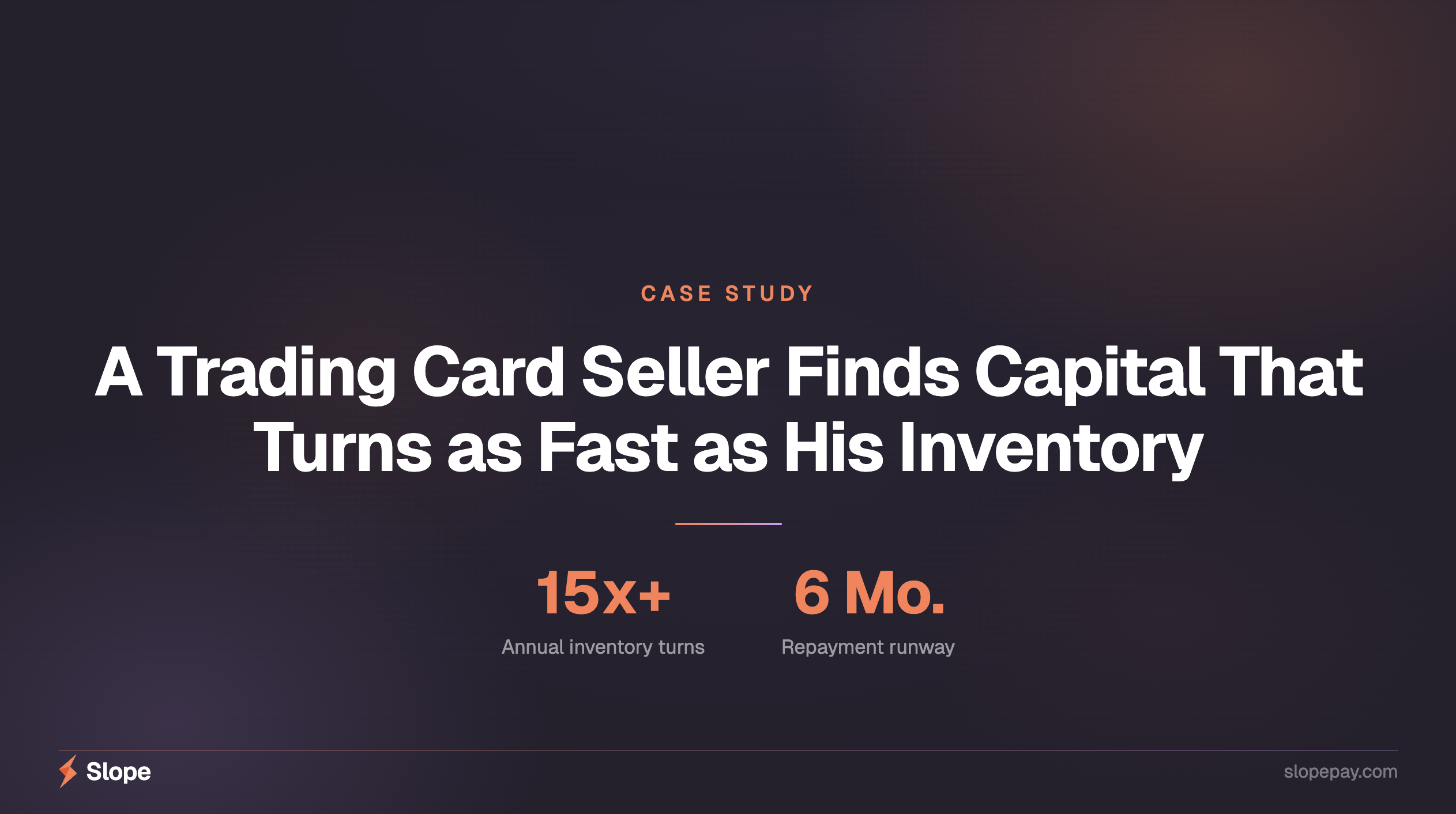
The Neato Company is the clearest documented example of buying deep at scale. Neato operates as the exclusive Amazon retailer for brands like Wiley Wallaby, Dots Pretzels, Earth Animal, and Illy Coffee. They're an 80-person company with nine-figure revenue and three consecutive years on the Inc. 100 fastest-growing companies list.
Before accessing Slope's revolving line of credit, Neato was locked into their suppliers' standard 30- to 45-day payment terms. They couldn't buy 90 days of inventory at once because their cash was cycling through Amazon's disbursement system. They couldn't pay suppliers on Day 1 because the money wasn't in their account yet.
With Slope's invoice financing, Neato started paying suppliers immediately and ordering in bulk. Over a six-month period, they captured an average 10% discount on inventory purchases. The discount was nearly four times what they paid in Slope financing fees. After netting out the cost of capital, Neato's margin expanded by 350 basis points on Slope-financed inventory and 550 basis points overall. The secondary effects compounded: deeper stocking across more FBA regional centers cut delivery times by 1-2 days, feeding into better organic placement and a 15% increase in sales velocity.
"With Slope, we were able to extend our inventory margins beyond what our typical 30- to 45-day terms with brands would have got us," CEO Anthony Connelly said. "Now we can go and buy 90 days' inventory by borrowing the money through Slope and paying brands on Day 1."
Read the full Neato case study →
The Funding Gap That Keeps Most Sellers Out
The sellers who know about buying deep but can't execute it all describe the same constraint: their capital is already deployed.
Amazon's standard disbursement cycle pays sellers every 14 days, but with reserves, the effective delay from sale to cash-in-hand is 21-35 days for most established sellers. The DD+7 policy adds another week for sellers who haven't yet received it. A seller doing $300,000 in monthly revenue might have $100,000 or more locked in Amazon's payout pipeline at any given time.
That's capital that isn't available to fund a larger supplier order. So the seller buys 30 days of inventory at the baseline volume tier, sells through it, waits for the disbursement, and repeats. Smaller orders at higher costs produce thinner margins and less free cash, which funds smaller orders again.
Sellers who have found ways to access working capital outside of the Amazon disbursement cycle describe being able to separate their purchasing timeline from their payout timeline. Neato's approach, using a revolving credit line to pay suppliers on Day 1 and order 90 days of inventory, is one example of how that separation works in practice.
Not every seller can or should pursue this approach, and not every product warrants it. The pattern tends to show up among established, high-velocity ASINs with predictable demand. It doesn't work well on new launches where demand is uncertain, or on products with high trend volatility where 90 days of inventory could become 90 days of overstock.
Slope's Amazon Line of Credit
For Amazon sellers who receive an offer through Seller Central, Slope's revolving line of credit* is available directly in the Amazon Lending portal. Revolving lines up to $5M, APRs as low as 8.99%, subject to credit approval and eligibility requirements. Supported by a J.P. Morgan credit facility, originated by Lead Bank, Member FDIC.
Each draw carries a fixed repayment schedule you set at the time of the draw — repayment does not accelerate based on revenue volume. As draws are repaid, the line replenishes for the next inventory cycle. The application uses a soft credit pull and does not affect your personal credit score. No personal guaranty required.
Check your eligibility in the Amazon Lending portal in Seller Central.
*Slope is a financial technology company, not a bank. Business-purpose loans made by Lead Bank and subject to credit approval. Application and consent to obtain personal credit report is required. Subject to minimum revenue and business requirements. Fees vary based on risk assessment and loan term.
Frequently Asked Questions
How much can Amazon sellers save by buying inventory in bulk?
For established, high-velocity ASINs with 12+ months of sales data, buying at volume discount tiers typically reduces per-unit COGS by 10-25%. Combined with early-payment discounts (2-3% per invoice) and timing advantages (ordering before peak shipping seasons), the total COGS reduction can reach 15-22% on a single purchase order compared to buying at minimum order quantities. The savings depend on the supplier's pricing structure, the seller's order volume, and how predictably the product sells through.
How much inventory should I buy for Prime Day?
Most seller guides recommend 3-5x your normal daily sell-through rate for the event window, plus a 20-30% buffer. For the full capital deployment timeline, see our Prime Day 2026 preparation guide.
What does "buying deep" mean for Amazon sellers?
Buying deep means committing to larger-than-normal inventory quantities on proven, high-velocity ASINs to capture volume discounts from suppliers. Instead of restocking in small batches every 30 days, sellers who buy deep order 60-90 days of inventory at once. The per-unit cost savings at higher volume tiers (typically 10-25% below minimum order pricing) offset the increased capital requirement. The term comes from Amazon seller communities where it's distinguished from "buying wide" (diversifying across many SKUs at smaller quantities).
How far in advance should I order Prime Day inventory?
90-120 days before the event for overseas-sourced inventory. For a mid-July Prime Day, that means supplier orders should be placed by late March or early April. Orders placed after May compete for supplier capacity during peak season, face longer lead times, and often incur expedited freight charges of $4-8 per kilogram versus $1-2 during standard periods.
This content is for informational and educational purposes only. It does not constitute financial, legal, or investment advice. Consult a qualified financial advisor before making any borrowing decisions.
Slope is a financial technology company, not a bank. Business-purpose loans made by Lead Bank and subject to credit approval. Application and consent to obtain personal credit report is required. Subject to minimum revenue and business requirements. Fees vary based on risk assessment and loan term.