

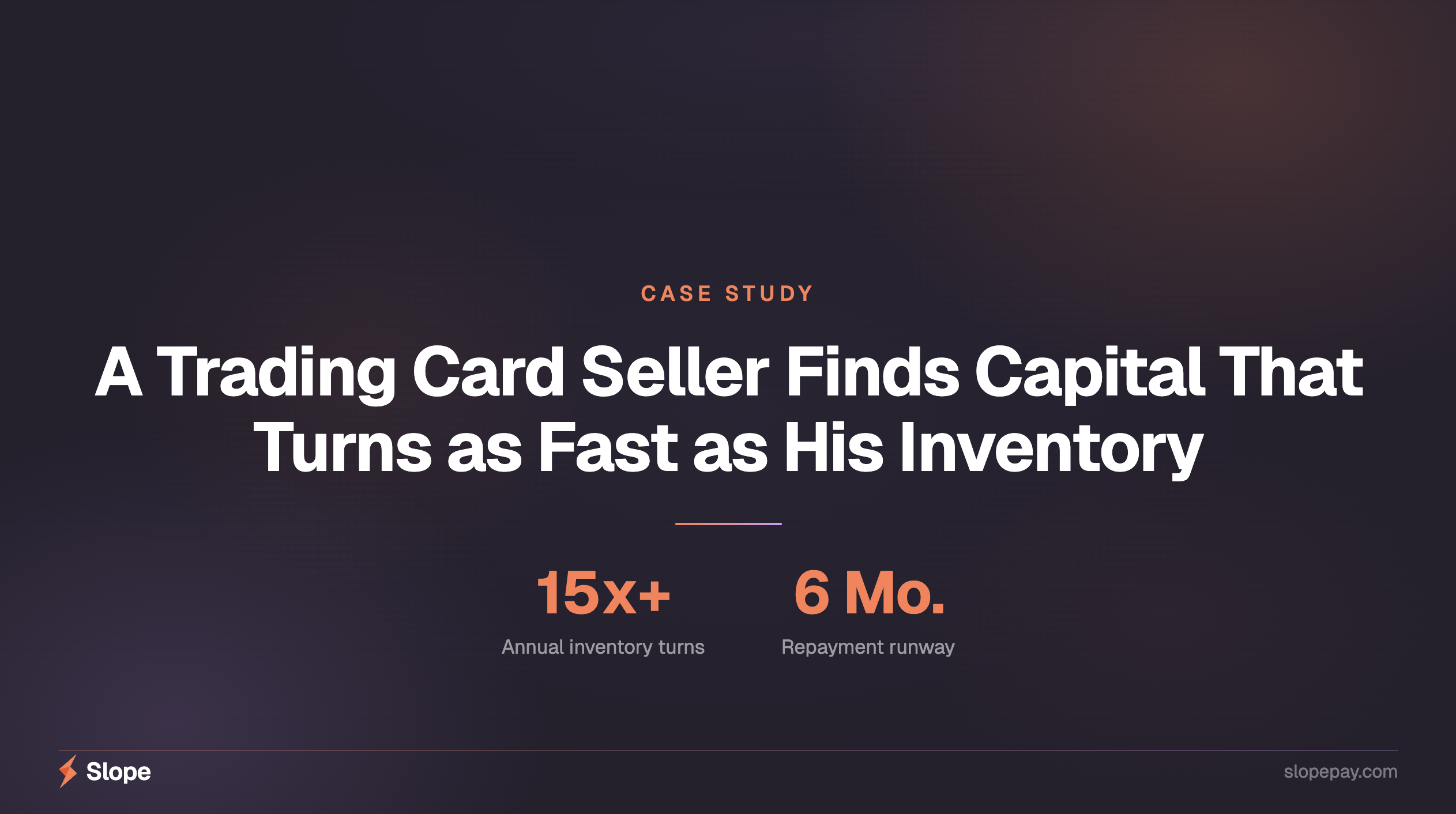
Continental Cards Trades Revenue-Based Financing for a Slope Line of Credit
Highlights
15x+ annual inventory turns
Strong net margin per turn, after fees
6 months Slope repayment term
In a Nutshell
Most trading card sellers hold inventory and wait for prices to rise. Patrick Nuckols does the opposite. With a background in accounting and finance, he built Continental Cards around a simple thesis: selling the same inventory over and over again, at competitive prices, generates the same return as speculation, with less risk. The model works, but only if capital moves as fast as the inventory does.
Continental Cards, his trading card business in Loudoun County, Virginia, incorporated in 2022 and opened its retail shop in 2024. Patrick sells sports and gaming cards across a retail store, e-commerce channels, live streaming, and international distribution.
In mid-2024, the trading card market entered an inflationary spike. Cards that sold for $120 in January were fetching $300 by August. Patrick wanted to scale into the wave. He applied to three financing products simultaneously, ran the comparison himself, and chose Slope.
About Continental Cards
Continental Cards sells sports cards and gaming cards — football, basketball, baseball, UFC, soccer, and gaming titles including Pokémon, Magic: The Gathering, and Yu-Gi-Oh — through a retail storefront, its own website, e-commerce platforms, live streaming openings, and direct international distribution. Part of the CAE Group portfolio, the business has become a community hub in Loudoun County, running league play, partnering with local schools and youth sports organizations, and positioning its retail shop as a destination for DC-area collectors.
Patrick Nuckols, owner and operator, comes from an accounting and finance background. He applies that discipline to every capital decision: he runs the numbers, compares the terms, and chooses based on unit economics.
Challenges
Continental Cards had never not been profitable. The case for outside capital was simple: faster scaling than the business's own margins would allow, timed to a market spike that wouldn't last.
- Outside capital was the only path to growth faster than the business's own margins could support
- Trading card prices spike and correct. Patrick deliberately limits how far in advance he buys to cap his exposure, which means he can't hold a large inventory buffer and needs capital accessible fast when opportunities appear
- Some financing products deduct a percentage of every sale as repayment, meaning strong sales periods accelerate payback, shortening the available runway precisely when the business has the most momentum to act on
- Short payback windows (30 days or less) limited borrowed capital to a single inventory turn before repayment
- Some products restricted financed capital to a single sales channel, limiting the flexibility to deploy it where it generates the best return
"We can only grow how much our margin will allow us. There was an opportunity to grow significantly more than that if we could get our hands on the capital."
— Patrick Nuckols, Owner, Continental Cards
Finding a Solution with Slope
Patrick flew to the Walmart Let's Grow! seller summit in mid-2025 for a few separate meetings. While waiting, he ended up next to the Slope booth and started a conversation. Within weeks, he was testing the Slope-powered line of credit alongside two other financing products simultaneously, for the same purpose.
The fee comparison came out close. The other products carried lower stated fees, but Patrick wasn't focused on the headline number: "When I'm comparing 2% to 3.5%, it's not a massive jump, especially since it's not compounding. it's just a fee assessment."
What mattered more was how each product's repayment structure affected what he could actually do with the capital. One product deducted a percentage of sales as they occurred, a common structure designed to align repayment with revenue. For Patrick's model, though, it meant that the faster he sold, the faster he paid back, which shortened the window he needed to turn inventory multiple times. The structure worked as designed; it just didn't fit his use case.
Another product carried a lower stated fee but restricted financed capital to inventory on its own platform and required full payoff before any new capital could be accessed. Patrick found the operational requirements limiting for a business that sells across multiple channels.
The more consequential variable was what he could do with the capital during the repayment window. A flat fee on a six-month draw, used to turn inventory at a healthy net margin per turn multiple times before repayment, generates a fundamentally different return than a lower fee on a 30-day draw supporting a single turn. Patrick's framework: margin per turn, multiplied by number of turns, minus the fee. The product with the lower stated rate wasn't necessarily the cheaper option.
Slope stood out in two areas. First, longer repayment terms: up to six months, negotiated directly with his account team in exchange for a slightly higher fee. With a 30-day payback, borrowed capital supports one inventory turn. With six months, Patrick can turn the same inventory multiple times before repayment comes due.
Second, revolving access to paid-back capital. As Patrick pays down a draw, that capacity becomes available again without reapplying, even while other draws are still outstanding. A collection available below market value becomes actionable. A time-sensitive deal doesn't get passed on.
"My goal is to turn it as many times as possible before paying it back, instead of just once."
— Patrick Nuckols, Owner, Continental Cards
The Impact
Patrick has since consolidated to a single financing product. One alternative is fully paid off; the other is in final repayment. Slope is his sole provider going forward.
- Moved away from revenue-based repayment structures that didn't fit his inventory-turn model
- A six-month repayment window lets Patrick turn the same capital multiple times before paying it back
- Revolving access enables opportunistic draws. Even while carrying an outstanding balance, Patrick can draw against paid-back capacity to act on purchases that generate strong gross margin after fees
- Capital flows to wherever it generates the best return, with no requirement to deploy into a specific channel or platform
"It's checked every box I needed it to check."
— Patrick Nuckols, Owner, Continental Cards
The Recommendation
When asked what he'd highlight for another business owner:
"Definitely the line of credit component — with accessibility to what's been paid back. And the big thing that was beneficial for me: I explained my situation, the desire to turn that inventory multiple times before paying it back, and Slope was able to service that request."
— Patrick Nuckols, Owner, Continental Cards
Ready to See Your Options?
Eligible Walmart Marketplace sellers can find Slope in the Capital Offers section of their Seller Center dashboard. If you see a Slope offer, you can apply — no commitment required just to check. Subject to application and credit approval.
*Slope is a financial technology company, not a bank. Business-purpose loans made by Lead Bank and subject to credit approval. Application and consent to obtain personal credit report is required. Subject to minimum revenue and business requirements. Fees vary based on risk assessment and loan term. Not all Walmart Marketplace sellers will receive an offer. Offer availability, credit limits, and terms are determined by Slope's underwriting criteria and may change at any time.
Individual results may vary. The outcomes described represent this customer's specific experience and are not guaranteed.

